
Find your match! What do you want to know?
LGBT dating apps like Taimi, Grindr, Tinder, and Badoo help you find people around the world. They bring together people with similar interests. This makes it easier to meet friends or partners online.
Advertisements
With these apps, you can choose someone based on your preferences and their identity. This makes initial conversations easier. This means you can form new friendships or relationships online.

Grindr
Meeting someone online complements real life, but it doesn't replace it. Studies show that the use of these apps has grown significantly recently, demonstrating their importance to the LGBT community.
It's important to take care of your security in these apps. They offer features like profile verification and control over who sees your profile. But there are still problems like harassment. Experts advise using apps carefully to avoid affecting your well-being.
Benefits of LGBT Dating Apps
Apps have changed how the LGBT community interacts globally. They offer spaces that facilitate the search for people with similar interests. Users feel safer exploring their identities, without the pressure of social media.
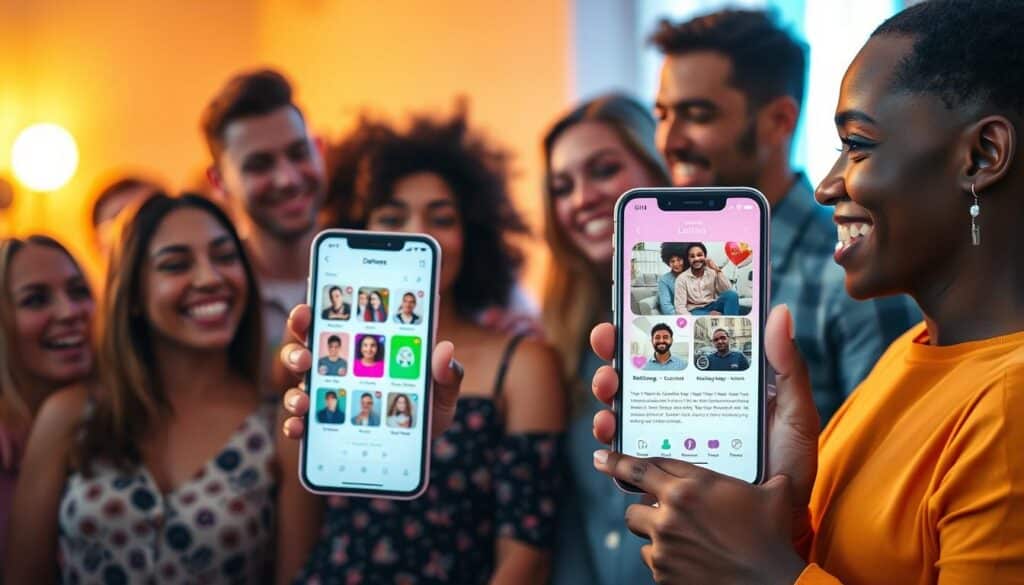
Visibility and meeting of people with common interests
App profiles showcase hobbies and lifestyles, helping you choose partners with a better affinity. According to Giulia Rossi, finding people with similar interests has become easier, without relying on physical events.

Hornet
Filtering by identity, orientation and preferences
Platforms like Taimi allow for gender and preference customization. These filters increase the confidence of those discovering themselves. This reduces misinterpretation and makes encounters more accurate.
Ease of pre-selection and reduction of social anxiety
Showing interests on profiles helps you choose better partners. Daiane Daumichen, a psychologist, says this reduces initial nervousness. Chatting before an in-person meeting reduces anxiety, according to users.
- Detailed profiles help you find the right partner.
- Filters make it easier to meet people with similar orientations.
- Pre-selection saves time and stress.
Google Trends indicates a growing demand for specific apps. This highlights the importance of tools that meet specific needs for security and compatibility.
Overview of the use of dating apps
People have been interacting differently lately. Across the world, many people of all ages and backgrounds have started using dating apps. The LGBTQIAP+ community plays an important role, supporting both general and specific apps.

Here
The use of these apps increases during challenging times, such as health crises. Studies explain how the market has adapted and changed during these periods.
Growth during and after the pandemic
During March 2020, online dating rose 82%, said the Dating.coThis is due to social isolation and the closure of places to meet people.
A Pew Research study found a 30% to 400% increase in the use of these apps in some places. This suggests that more people began using these services, and continued using them even after the pandemic eased.
Search trends and most popular apps
Since 2013, many people have been looking for online dating apps, reveals the Google Trends. Interest increased further in 2022 as restrictions eased.
In the world, the most sought after apps are Tinder, Badoo and Grindr. Each one has its own characteristics, like Tinder and its swipe system, Badoo which lets you chat without matches, and Grindr, important among gay men.
- Bumble: stands out for allowing women to initiate conversations.
- Happn: focus on meeting people you meet on the day.
The growth of online dating reflects changes in our habits. Search engines and Google Trends are useful for understanding what people are looking for.
Security and privacy in LGBT apps
Dating apps offer opportunities to meet new people, but they also carry risks. It's crucial to know how to protect your personal information online. Because each app has different security rules, it's a good idea to research thoroughly before using it.
Exposure verification and control features
Some platforms require verification methods to confirm your identity. Taimi, for example, requires facial recognition, a password, and a fingerprint to ensure security.
These actions increase confidence and decrease the chances of encountering fake profiles. But, it's always a good idea to adjust your profile's privacy settings.
Good practices to reduce the risk of violence
Don't put too much personal information on your profile. Choose popular places for first dates and let your friends know about your plans.
- If something seems wrong, use the report and block options.
- Take a good look at the person’s photos and history before trusting them.
- If possible, use apps that verify identity well, like Taimi.
Stories of transphobia and violence highlight the importance of caution. Experts advise watching for warning signs and performing basic checks to protect yourself from harassment.
Know the rules of each platform
Platforms like Grindr, Badoo, Tinder, Happn, and Bumble have their own policies. It's important to understand how they handle your messages and privacy before making the first contact.
Follow safety tips and take advantage of technologies such as facial recognition, helps to keep the safety in LGBT apps. This way, you protect yourself without losing the good side of meeting new people.
Inclusive environments and diversity of options
The search for connections is changing with the variety of platforms. Apps for the LGBT community have emerged, focusing on preferences, identities, and safety. This meets needs not seen in larger networks.
These apps target specific audiences. For example, Wapa is loved by lesbian and bisexual women. Grindr is a favorite among gay men. And Her is a space created for female diversity.
- Taimi All Inclusive It offers a wide environment, with many filter options, profile cards and security.
- Platforms like half crown unite people of similar ages with the same interests.
- Specialized LGBT apps make finding affinities faster, but still require safety precautions.
Inclusive dating apps offer technical tools and sound moderation policies. This includes filtering and visibility adjustments to personalize the experience.
Those who value privacy will like the Taimi All Inclusive and its advanced features. Those who prefer smaller groups can choose more specific platforms. This variety expands the ways to find genuine connections.
Impact on mental health and self-esteem
Dating apps have changed how the LGBT community interacts. They offer a sense of community and support. However, they can also increase pressures on appearance, damaging self-esteem.
Benefits: sense of belonging and social support
Psychologists like Daiane Daumichen and Layla Thamm point out that meeting similar people reduces isolation. Apps that allow you to filter by identity help you find safer encounters.
The support from these platforms can be incredibly helpful for your mental health, creating a space to be yourself and feel validated.
Risks: comparison, rejection, and dependence on digital validation
The design of these apps encourages quick choices, which increases comparison and can worsen anxiety. This mainly affects LGBT self-esteem.
The constant search for online approval and rejection hurts. Furthermore, imposed beauty standards reinforce prejudices, negatively affecting self-esteem.
Tips for conscious use to protect self-esteem
- Before using an app, ask yourself: Is this an escape? Am I demanding too much of myself?
- Set up your profile to express your expectations and limits, making your app usage healthier and avoiding bad encounters.
- Use tools to maintain your privacy and control what you share, such as those available on Taimi, to avoid unnecessary exposure.
- Try to balance your online life with your real life by going to safe places offline and keeping friends close.
- If these apps are negatively affecting your self-esteem or mental health, don't hesitate to seek professional help.
Ease of forming affective and social networks
Dating apps are great for forming LGBT affective networksThey have detailed profiles. This helps users search for anything from friendships to romance. Many users find companionship even with little in-person social life.
Friendships and casual encounters — Taimi and Badoo have filters and cards that facilitate friendly or flirtatious conversations. Making new friends or finding someone to hang out with becomes easier.
Serious relationships — Profiles show interests. This helps you find someone for a stable relationship. Filters highlight commonalities and important values.
Polyamorous relationships — Taimi allows people to express interest in polyamory. This allows people to explore these relationships openly and with consent.
Simple features can lead to special encounters. A matching system brings together people with similar interests. Text and audio messages increase intimacy before meeting in person.
Video calls are a safe way to test chemistry without leaving home. Chat and audio bridge the gap. They make it easier to decide whether to meet someone in person.
Swipes and discovery — Tinder and Grindr quickly select profiles. This is a great way to make quick connections, ideal for those who value speed.
Pre-match conversations — Badoo encourages conversation before matching. This can improve the quality of encounters, turning contacts into true friendships.
When you have a clear objective, these tools increase the chances of forming LGBT affective networksWith conscious use, these apps are the beginning of lasting friendships.
Access for underrepresented groups and diverse age groups
Dating apps are great for those with limited local visibility. They come with filters and options that allow you to find people outside your area. This helps underrepresented groups and facilitates new connections.
Some apps are designed for specific ages and interests. Interest in services for people over 40 is 13,4% in Google Trends. Sites like half crown help you find someone with similar life experiences. Dating apps for those over 40 promote mature conversations and clear expectations.
Taimi and other platforms allow users to choose between meeting people near or far. Users can search for local or international partners. This reduces loneliness and increases the chances of finding someone special.
- Pre-selection by profile: makes it easier to find common interests without relying on the local scene.
- Age-specific options: reduce noise between different expectations and improve match quality.
- Geographic filters: allow you to search by city, region, or internationally.
Even as apps expand reach, caution when meeting in person is essential. Always check profiles, choose public places, and notify a friend. Technology makes dating safer, without forgetting to be cautious.
Features and functionality that enhance the experience
Dating apps have come a long way. They make dating more efficient and safer. Users appreciate easy-to-use tools. They help them choose the right people, verify who they are, and find potential matches faster.
Some tools have changed the way we meet new people. For example, Tinder introduced the ability to quickly swipe between profiles. Platforms like Taimi offer a way to see if two people are compatible. They allow users to reveal more about themselves in detail.
- Swipe and cards: Swiping on Tinder helps you make quick decisions. Detailed profiles make a good first impression.
- Extended filters: With Taimi's filters, you can search for people with similar interests. This helps you avoid matches that don't work.
- Undo options: The ability to go back prevents careless mistakes. This makes the app easier to use.
Having security and being able to verify who people are is very important. Profile verifications with facial recognition, documents, and photos create more trust. Accounts that pass this test display a seal. This reduces the risk of being found fake profiles.
- Verification and Privacy: Profile verification uses various methods, such as biometric recognition and mobile verification.
- Audio and video validation: Making a call or sending a voice message is a way to know if someone is who they say they are before you meet them.
- Secure accounts: Having a password, using a fingerprint, and being able to lock by region helps protect your account.
Well-designed dating apps balance discovering new people with security. It's important to have tools to moderate and report profiles. Features like seeing who's visited your profile, highlighting it, and filtering searches make the experience more personalized.
When choosing an app, consider how it combines ease of use with security. Rich profiles, multiple ways to verify someone's identity, and privacy options make all the difference. They transform the way people interact and reduce risks.
Combating prejudice inside and outside apps
Dating platforms are crucial in combating discrimination. They need clear rules, ways to report issues, and ongoing user education. This way, everyone can help create a safer environment.
To prevent abuse, some actions are essential. Many have already suffered from transphobia, misogyny, and other attacks on apps. Therefore, teams that control content need to act quickly. Taimi uses verification and privacy to help, but risks still exist.
- Report and document: Always save conversations and file official reports. This helps fight transphobia.
- Block and prioritize security: Choose to meet people in crowded places and tell someone you trust where you will be.
- Use verification: Use verification systems on profiles. This reduces the chance of finding fake accounts.
Technology has its limits. Content moderation teams must deal with many users, and some try to disguise themselves. Fake profiles are a problem for both technology and people, who need better algorithms and stronger rules.
Educational initiatives and updated rules make a difference in people's behavior. Platforms with dedicated teams, clear appeals processes, and good communication are more successful in addressing transphobia and improve their response to these issues.
App users can follow simple tips to protect themselves. Don't give out personal information, verify that the person is who they say they are, and report abuse. Combining user attitudes with platform actions strengthens the fight against prejudice, making digital environments safer for everyone.
Connection between online life and real life
Apps help you meet new people. Those who grow up online often need to consider the balance between virtual and real. Psychologists warn: using apps alone can affect how we interact in person.
To maintain a good balance, turn off notifications for a while. Accept going to parties and events. Join groups with similar interests. This maintains the importance of personal contact and prevents app dependency.
How to balance digital meetings with in-person opportunities
- Before meeting, video chat. This helps you get to know the person better before meeting in person.
- Limit your time on apps and opt for outdoor activities.
- Go on your first date in a public place and let your friends know. This will make you feel safer.
Tips for developing social skills outside of apps
- Talk to people at bars or events. Short conversations can strengthen your social skills.
- Joining workshops, volunteer groups, or playing sports helps. These activities are great conversation starters.
- Consider whether the app helps or hinders, as Layla Thamm says. Adjust usage based on the actual benefits.
Using digital tools and real-life experiences makes relationships more authentic. Switching between online and in-person relationships improves quality of life and increases the chances of safe encounters.
Relevant cases, statistics and trends
The use of dating apps worldwide is growing. This increase is highlighted in studies, news reports, and among users. There is data showing differences by region, increases at certain times, and how people search for partners. This information is important for understanding how people behave and the risks involved.
Pew Research found that usage of these apps has grown between 30% and 400% depending on location. This fact highlights how important these platforms are for all ages and in different locations.
- Pew Research increases usage: growth varies, being greater in cities.
- Dating.co saw an 82% increase in online dating in March 2020, the start of the quarantine.
Google searches show strong interest in specific types of dating. On Valentine's Day, for example, searches were the highest since 2004.
- Google Trends shows that gay dating services account for 70,73% of searches.
- Lesbians with 12,19%, people over 40 with 13,4% and celebrities with 3,65%.
Search numbers began to rise in 2013. In 2022, they increased again with the lifting of some pandemic restrictions. The most popular apps worldwide are Tinder, Badoo, Grindr, Bumble, and Happn.
There are also cases that highlight the risks of online dating. For example, an investigation into Grindr in Curitiba in 2021. These cases demonstrate the need for clear safety rules and campaigns to inform users.
- Monitoring: Viewing dating app statistics helps identify the biggest risks.
- Prevention: Use data from Pew Research and Google Trends to warn of dangers.
- Education: Teach users how to protect themselves and create ways to report issues.
These insights provide a comprehensive overview for app developers, authorities, and users. Statistics help you make better decisions, always keeping safety and diversity in mind.
Conclusion
LGBT dating apps offer many benefits. They increase visibility and make it easier to find people with similar interests. They also help create supportive communities that were previously more difficult to find. Platforms like Taimi, Tinder, and Grindr demonstrate that safety can be improved through features like profile verification, filters, and video calls.
However, it's important to consider the risks. These risks include issues with users' self-esteem and safety. Research from the Pew Research Center, Dating.co e Google Trends discuss the increased use of these apps. They also highlight the importance of having effective tools to combat online harassment.
Looking ahead, LGBT dating apps worldwide need to balance innovation and safety. Safety tips include preferring verified profiles, making good use of privacy options, and listening to psychologists' advice on how to use these apps healthily. It's also crucial to report any bad behavior. Thus, apps serve as a good complement to meeting people, without replacing real relationships.