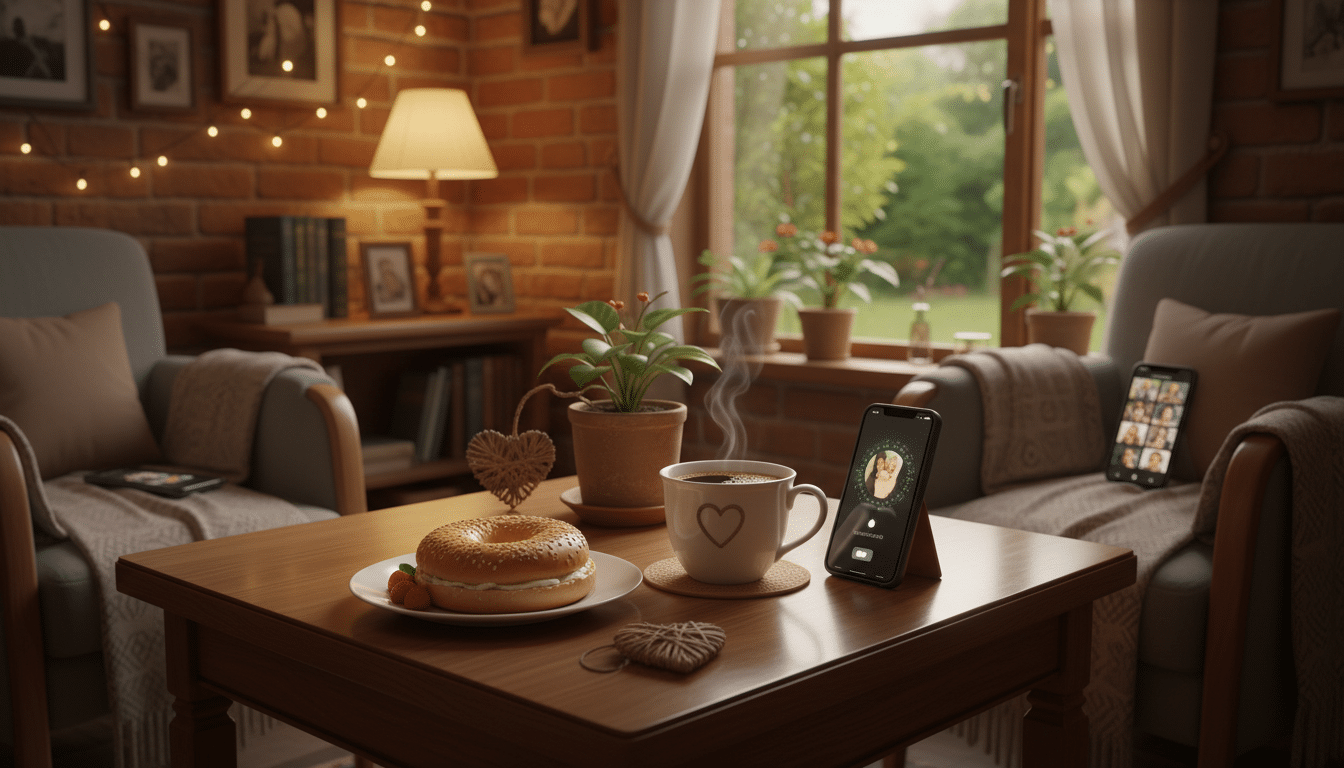
Technological advancement has revolutionized long-distance dating. Now, beyond videos, couples can feel each other’s touch. Devices mimic hugs and even heartbeats, making the relationship feel more intense.
Innovative products like the Hey Bracelet, RingU, and Pillow Talk are gaining popularity. Alongside them, the Flex-N-Feel gloves and the Kissenger create sensations of touch and kisses. There is also the The Hug Shirt and VR systems like MyEyes, which shorten the distance between couples.
Ads
This text explores how these technologies assist in long-distance relationships. It covers their functions, limitations, and how to use them safely. The focus is to support those in long-distance relationships, paying attention to privacy and security.
How technology transforms long-distance dating
Technology has changed the way we date from afar. Previously, messages and video calls were a novelty. Now, they are essential. Couples seek tools to feel each other’s presence, despite the miles of distance.
Long-distance dating began with letters and phone calls. Today, the internet and smartphones allow for communication at any moment. However, we still miss physical contact. People are more mobile nowadays. Therefore, they want technologies that mimic real sensations and daily moments.
New developments include wearables and devices that mimic touch. There are bracelets, rings that vibrate together, and even haptic shirts and gloves. Technologies that transmit heartbeats and scents are being created. There is also virtual reality, which helps in sharing activities and special moments.
- Pillow Talk and wearables that share physiological signals make daily life feel more intimate.
- VR solutions allow for seeing from the other’s point of view and participating in joint routines.
- Telepresence robots have been tested in laboratories and academic studies.
New affective tools improve the connection between long-distance couples. Research shows they can reduce feelings of loneliness. According to studies from Simon Fraser University, the most important aspect is feeling connected.
However, there are ethical challenges with these technologies. They include dependency and privacy concerns. These topics are already being discussed by researchers.
Long-distance dating with the help of technology
Technologies such as haptic, wearable, and remote presence devices are changing the lives of those in long-distance relationships. They help reduce the longing we feel and allow for creating moments together, even while apart. We will show some examples currently in use.
Haptic devices that simulate touch
-
The Hey Bracelet is a wristband that you can make vibrate using an app. Its design aims to mimic a gentle, quick touch on the arm.
-
The RingU is a touch-sensitive ring. When you touch it, your loved one feels a soft vibration on their ring.
-
The Flex-N-Feel consists of a pair of gloves that capture and send touch. The Flex glove captures your movements, and the Feel glove vibrates for the other person to sense.
Wearables that share heartbeats and sensations
-
The Pillow Talk is a wristband that lets you hear the heartbeat of the one you love. It sends the sound to a speaker under the pillow.
-
There are wearables that show heart rate and body temperature. With them, it can feel like we are closer to each other every day.
Virtual reality and telepresence solutions to share space
-
The MyEyes connects video conferencing to virtual reality glasses. This way, partners see the world through each other’s eyes, making the relationship feel closer.
-
Telepresence robots act as if they were the loved one in another location. They are useful for doing things together, even from afar.
-
The Be With Me project blends virtual reality with real life. It allows for sharing daily details to feel the partner closer.
Gadgets that recreate touch and hugs
The search for remote tactile sensation has resulted in interesting inventions. We have everything from discreet wearables to full-body clothing. They transform physical touch into digital signals, maintaining intimacy and presence between people who are far from each other.
Haptic bracelets and rings
Bracelets that send touches via an app are winning hearts. For example, the Hey Bracelet allows for sending simple touches, helping the pair feel each other’s presence.
The RingU ring, with its sensitive sensors, is also an option. It allows for sending an “I’m thinking of you” without words. This helps couples communicate in a discreet and meaningful way in their day-to-day lives.
Haptic shirts and gloves
There are garments made to simulate hugs. The Hug Shirt captures and sends the sensation of a hug to the one you love. It can recreate the pressure, duration, and even the temperature of a real hug.
At Simon Fraser University, researchers created the Flex-N-Feel gloves. They reproduce the sensation of touching someone’s hands or face, adding more emotion to gestures than a simple touch could.
Technical limitations and prototype stage
There are still many challenges to overcome with these gadgets. They need more accurate sensors and lower transmission latency. They also lack the ability to fully mimic different textures and pressures.
Issues like real-time synchronization, comfort for long-term wear, and compatibility with mobile phones and Wi-Fi are challenges. Furthermore, there is the matter of cost and safety regulations to consider.
- Advantages: emotional proximity, non-verbal messages, and shared experiences.
- Disadvantages: immature prototypes, latency, limited precision, and cost.
- Current focus: improving sensors, reducing latency, and making designs more comfortable.
Advanced sensory experiences: kissing, heartbeats, and massage
Technology joins affection, creating bonds between partners even at a distance. We explore how current products and research create ways to connect people, going beyond words and videos. These innovations offer tactile and synchronized experiences that make presence feel more real.
Remote kissing devices
The Kissenger is a device that turns a kiss into digital signals. It features a silicone accessory that, when attached to a smartphone, captures the pressure and movements of the lips. This information is sent in real-time to the partner’s device. Thus, the sensation of the kiss can be felt and responded to in a bidirectional way.
Another innovation is an “artificial mouth” developed in China. It simulates a kiss with pressure, movement, and warmth. Connected via Bluetooth, it allows for recording and replaying kisses. This experience is intended for couples in long-distance monogamous relationships.
Pillow Talk and heartbeat transmission
Pillow Talk is a system that combines a wristband and a pillow speaker. It transmits the user’s heartbeat in real-time, allowing the partner to hear the heartbeat while sleeping, creating a sense of closeness.
Devices that share heartbeats prove to be powerful in strengthening bonds. Hearing a partner’s heartbeat brings tranquility and the feeling of being together, even when apart.
Interfaces for massage and shared actions
Researchers are developing ways to provide remote massages using soft robotics and haptic actuators. This allows one partner to control the touches while the other feels the stimuli in specific areas of the body.
Remote massage devices are being improved. The goal is to make the touch safe and natural. Sensory gloves and systems that mimic human movements are being tested, allowing for the stimulation of specific body points from a distance.
- Kissenger remote kissing appears as a pioneering technology in the field.
- Pillow Talk heartbeats demonstrates how physiological signals can create presence.
- remote massage devices show the path toward controlled remote touch.
- dating sensory experiences combine these resources to make affection more tangible.
These technologies do not replace physical contact, but they expand the ways of relating. They help maintain affection-filled routines, synchronize feelings, and explore new intimacies. This is especially valuable when distance calls for creative solutions.
Virtual reality, telepresence, and sharing experiences
Remote presence technologies make couples feel closer despite the distance. Devices that mix video, audio, and sensors allow for participating in routines and outings as if they were together.
Glasses and systems to “see through the eyes of the other” (MyEyes)
The MyEyes uses virtual reality for someone to see the world from their partner’s perspective through VR glasses and live streaming. The idea is to increase understanding and share simple moments, such as walking or cooking.
Studies show that this improves the feeling of being together and positively impacts communication and doing things as a pair. However, for it to work well, stable internet connections and easy-to-use systems are necessary.
Telepresence robots and participation in joint activities
Mobile robots allow people to participate in domestic life from a distance. The telepresence robot acts as a physical substitute for the person who is far away, assisting in dates, dinners, and daily tasks.
Experiments in various countries with commercial platforms have shown that couples feel more present with robots that move and have cameras at human eye level.
Research cases from Simon Fraser University and interaction labs
Simon Fraser University develops innovative projects like Flex-N-Feel, Be With Me, and MyEyes. These come from Carman Neustaedter’s Lab, focused on testing the usability and emotional impact of these technologies.
The work documents experiments with volunteers and verifies how reliable these technologies are. It seeks to integrate sensors, glasses, and robots to improve the sensory experience, even when one cannot be physically present.
- Practical applications: virtual tours, participation in events, and help with household chores.
- Technical challenges: improving command response, glasses comfort, and robot autonomy.
- Usage perspective: increasing empathy, ensuring privacy, and facilitating access for all.
Apps and digital practices to strengthen the bond
Digital routines can support affection between couples in different cities. They can create shared digital rituals. The right tools bring a sense of presence and ease to daily life.
Apps for syncing movies, walks, and routines
There are apps that allow couples to watch series and movies together from a distance. With these co-watching platforms, it is easy to organize synchronized movie nights.
Other apps help share walks and daily routines. Using shared calendars and reminders facilitates planning and avoids confusion.
Using video conferencing for daily intimacy
Short and regular video calls help maintain visual and emotional connection. Establishing rituals, such as having dinner or coffee together, enriches the relationship.
Projects with virtual reality and telepresence make interactions more real, as if they were sharing the same physical space.
Good practices for communication, privacy, and security
Talking about privacy and rules is essential before using new technologies. It is important to define how to handle intimate content.
- Check the privacy policies of apps for couples.
- Protect connections with firmware updates and secure networks.
- Consider the emotional impact of using sensors that collect heartbeat or touch data.
Paying attention to costs and data security reduces problems. Clear dialogue maintains trust while exploring new ways of connecting.
Conclusion
Haptic wearables, such as bracelets and rings, and sensory clothing, like The Hug Shirt and Flex-N-Feel, are innovative. Kissing devices like the Kissenger and solutions like Pillow Talk for hearing heartbeats join VR and telepresence robots. These, like MyEyes and platforms from Suitable Technologies, create a bright future for long-distance dating.
Technology and intimacy can diminish the feeling of distance. They help strengthen shared routines between couples. However, many of these innovations are still in development. They face challenges like latency, high cost, and limitations in tactile sensation, which hinders widespread use.
A tip is to blend technological tools with effective communication and clear privacy rules. Start by trying simple devices before moving on to more advanced options. View technology as a complement to physical contact, never as a substitute. This approach can increase the chances of a long-distance relationship succeeding in the future.
Content created with the help of Artificial Intelligence.